
Alright, let's talk about something that still gets the Minecraft community buzzing—the great firefly fiasco. Even in 2026, as we marvel at the latest holographic Nether biomes, the ghost of those scrapped glowing bugs haunts us. Mojang's decision to cancel fireflies back during the Wilds update planning was like finding a diamond pickaxe and then realizing it's made of painted wood—a huge letdown wrapped in confusing logic. The official reason? Realism. Fireflies are apparently poisonous to frogs in real life, so they couldn't, in good conscience, let pixelated frogs snack on pixelated fireflies. Meanwhile, in the same game, those same frogs are happily munching on magma cubes to poop out froglights. The cognitive dissonance is thicker than a chunk of deepslate!
The Update That Glowed... And Then Didn't
Fireflies were supposed to be the shimmering jewel of the 2022 Wilds update. Imagine it: twilight forests dotted with tiny, floating points of light, adding a layer of magic to the already enchanting nights. The community was hyped! Concept art floated around, and it felt like a perfect, atmospheric addition. Then, in an episode of "Ask Mojang," producer Anna Lundgren dropped the news. They were scrapped. The reason hit the community like a rogue creeper blast. Realism. Specifically, the real-world toxicity of fireflies to frogs.
This reasoning opened a Pandora's box of questions. Minecraft has never been a wildlife documentary. It's a world where you can ride a pig off a cliff with a carrot on a stick, build a computer inside the game using redstone, and where gravity-defying sand blocks are a constant, frustrating reality. Choosing this moment to get biologically accurate felt as random as a wandering trader offering you a single piece of string for three emeralds.
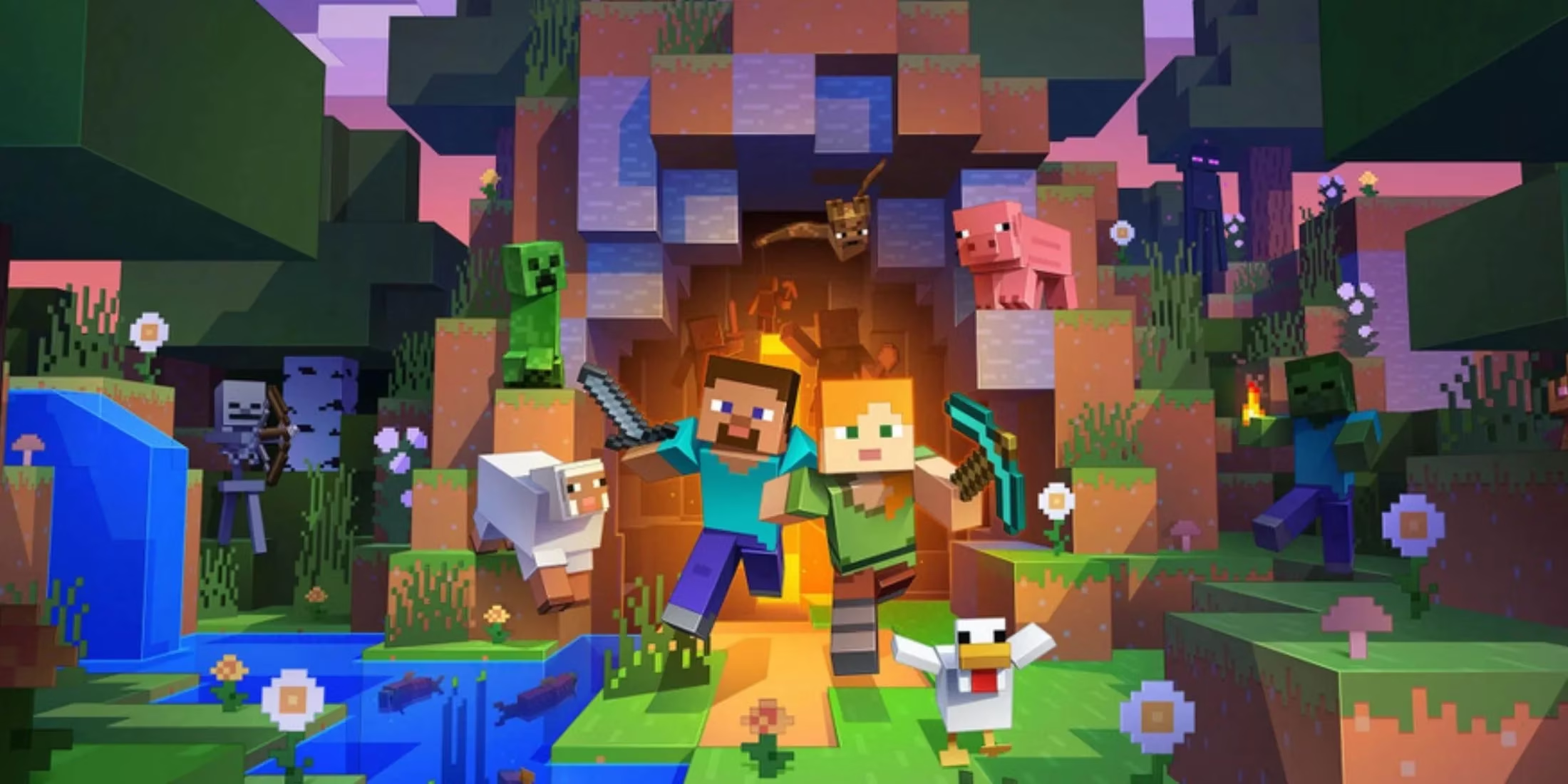
Atmosphere vs. "Accuracy": The Core Conflict
Minecraft's soul isn't in its realism; it's in its limitless, creative potential. It's a digital sandbox where the only rule is your imagination. Players don't come here for a perfectly simulated ecosystem. They come to build castles in the sky, automate entire farms, and create stories. The game's longevity is built on this freedom. Enforcing a hard-line ecological rule about fireflies and frogs felt like someone putting a "Do Not Touch" sign on a Lego set. It went against the game's foundational spirit.
That's not to say all realism is bad! The recent addition of falling leaves, for example, was a masterstroke. It doesn't change gameplay mechanics in a restrictive way; it purely enhances the feeling of being in an autumn forest. It adds atmosphere, not bureaucracy. The firefly decision, however, subtracted a potential source of beauty and wonder for the sake of a footnote in a biology textbook that the game itself constantly ignores.
The Legacy of a Missing Mob
So, where does this leave us in 2026? The firefly debate has become a kind of cultural touchstone within the community. It's a case study in game design philosophy. On one side, you have the argument for consistency and education (even if it's selectively applied). On the other, you have the passionate plea for whimsy and aesthetic joy over simulated realism.
Every time a new, slightly "unrealistic" feature is added—like the glowing squids that don't actually illuminate much, or the allay that defies several laws of physics—someone inevitably brings up the fireflies. They've become the poster children for missed opportunities, a shimmering "what if" on the periphery of the game's world.
What Could Have Been: A Simple Fix
The community's proposed solutions were (and still are) brilliantly simple, highlighting how unnecessary the cancellation was:
| Community Solution | How It Solves the "Problem" |
|---|---|
| Non-Toxic Fireflies | Just... make them not poisonous. It's a game! |
| Separate Spawning | Have fireflies spawn in different biomes than frogs. Problem solved. |
| Aesthetic Only | Make them purely ambient particles, like ash in the Nether, that frogs can't interact with. |
It feels like Mojang chose the most complicated solution to a problem they invented. The whole situation was like watching a master chef refuse to add a pinch of salt to a stew because, technically, too much sodium is unhealthy—while simultaneously serving the stew in a bread bowl made of pure sugar.
The Bigger Picture: Minecraft's Identity
At its heart, Minecraft is a game of contradictions, and that's part of its charm. It's both brutally simple and infinitely complex. It has rules, but they are meant to be bent, broken, and rebuilt into something new. The firefly incident, for many, felt like a momentary lapse in understanding what makes the game truly special. It prioritized a narrow, literal interpretation of one real-world fact over the expansive, dream-like logic that allows the game to exist in the first place.
As we look at the game today, thriving with new blocks, mobs, and mechanics, the lesson of the fireflies remains. Players cherish additions that spark wonder and fuel creativity. They're less enthusiastic about restrictions justified by a reality that the game joyfully abandons in every other dimension. The magic of Minecraft isn't in mimicking our world, but in giving us the tools to build a better, brighter, and much more interesting one of our own—preferably with lots of twinkling lights in the evening sky. The absence of those tiny lights is a reminder that sometimes, the most realistic choice isn't the most fun one.